
.png)



Flexible, Client-Managed Testing Teams: Scaling with PLUS QA Dedicated Resources
Engineering teams rarely run out of QA bandwidth all at once. The test load grows as products launch, mature, and multiply. A product team ships faster, regression testing takes longer, a mobile app has to work across more devices, and a web product adds new user roles, payment paths, accessibility requirements, or AI-driven features. The internal QA team keeps covering the work until the release schedule starts to outpace the team’s testing capacity
Hiring can solve part of the problem, though recruiting rarely matches the timeline of a release schedule. QA is specialized work. Demand for software developers, QA analysts, and testers is expected to keep growing through 2034. Recruiting, onboarding, training, and retaining that talent takes time most teams do not have when launches, sprint cycles, and customer commitments are already in motion.
Dedicated resources give clients assigned QA professionals who work as an embedded extension of the client’s team. The client keeps direct control over daily work, priorities, tools, and execution. It is a flexible way to scale QA capacity without adding internal headcount, building a larger device lab, or asking developers to take on more testing than their role should require.
What Dedicated QA Resources Actually Are
Dedicated QA resources give engineering teams focused QA support for one client account, centered on full-time or part-time testers who work inside the client’s tools, workflows, and release cycles. They do not rotate through unrelated projects from week to week. Over time, they learn the client’s product, tools, workflows, release schedule, and testing standards.
The client directs the day-to-day work. A product manager, QA lead, engineering lead, or release owner can assign test cases, set priorities, review results, and guide testing inside the same systems the internal team already uses. That may include issue-tracking tools like Jira or Linear, test management platforms, communication channels like Slack or Teams, and development workflows in tools like GitHub.
Dedicated QA resources create a different working relationship than a standard vendor handoff. The client is not giving up control of testing priorities and execution or waiting for a separate team to interpret findings from the outside. The tester works within the client’s sprint cycle and release workflow, sees changes as they happen, and adjusts testing as priorities shift.
How the Dedicated Resources Model Differs From Other QA Models
QA support can add capacity in different ways. Staff augmentation, managed QA services, and dedicated resources can all help engineering teams cover more testing. What changes is the working relationship between the client and the tester, from who directs the work to how closely testers fit with the internal team and how much continuity carries from one release to the next.
Staff augmentation
How it works:
Testers are added to increase short-term capacity, often with less day-to-day integration into the client’s QA process or product workflow.
Best fit:
Temporary support for a defined workload.
Managed QA services
How it works:
A QA provider leads strategy, planning, execution, reporting, and overall delivery.
Best fit:
An outside partner to manage the QA function or a major testing program.
Dedicated resources
How it works:
QA professionals are assigned to one client and work inside the client’s tools, workflows, and sprint cycles. The client directs daily priorities while testers operate as embedded members of the team.
Best fit:
Flexible QA capacity without giving up execution control.
Dedicated resources make the most sense when internal leaders know the QA plan and need experienced testers to help carry it out. The approach provides more continuity than basic staffing changes and keeps more daily direction with the client than managed QA services. The client gets steady QA support aligned with the same priorities, release goals, and product standards as the internal team.
Why Teams Move Toward Dedicated QA Resources
QA capacity often becomes a problem before hiring can solve it. An internal team may be able to cover the normal workload until a launch, platform change, seasonal push, or large regression cycle adds more testing than the team can absorb. Specialized QA talent can also be difficult to recruit and retain, especially when the need is urgent or likely to change after a release.
The challenge isn’t only headcount. It’s timing. A team may need more QA coverage next sprint, not next quarter. A product group may need deeper device coverage for a launch, then steady regression support after the release. A startup may need enterprise-level testing discipline before it has the budget or structure for a larger internal QA department.
Dedicated QA resources give teams another option. They can expand testing capacity while keeping direction close to the product team. That gives engineering leaders more coverage without forcing every QA need through recruiting, HR, procurement, and onboarding.
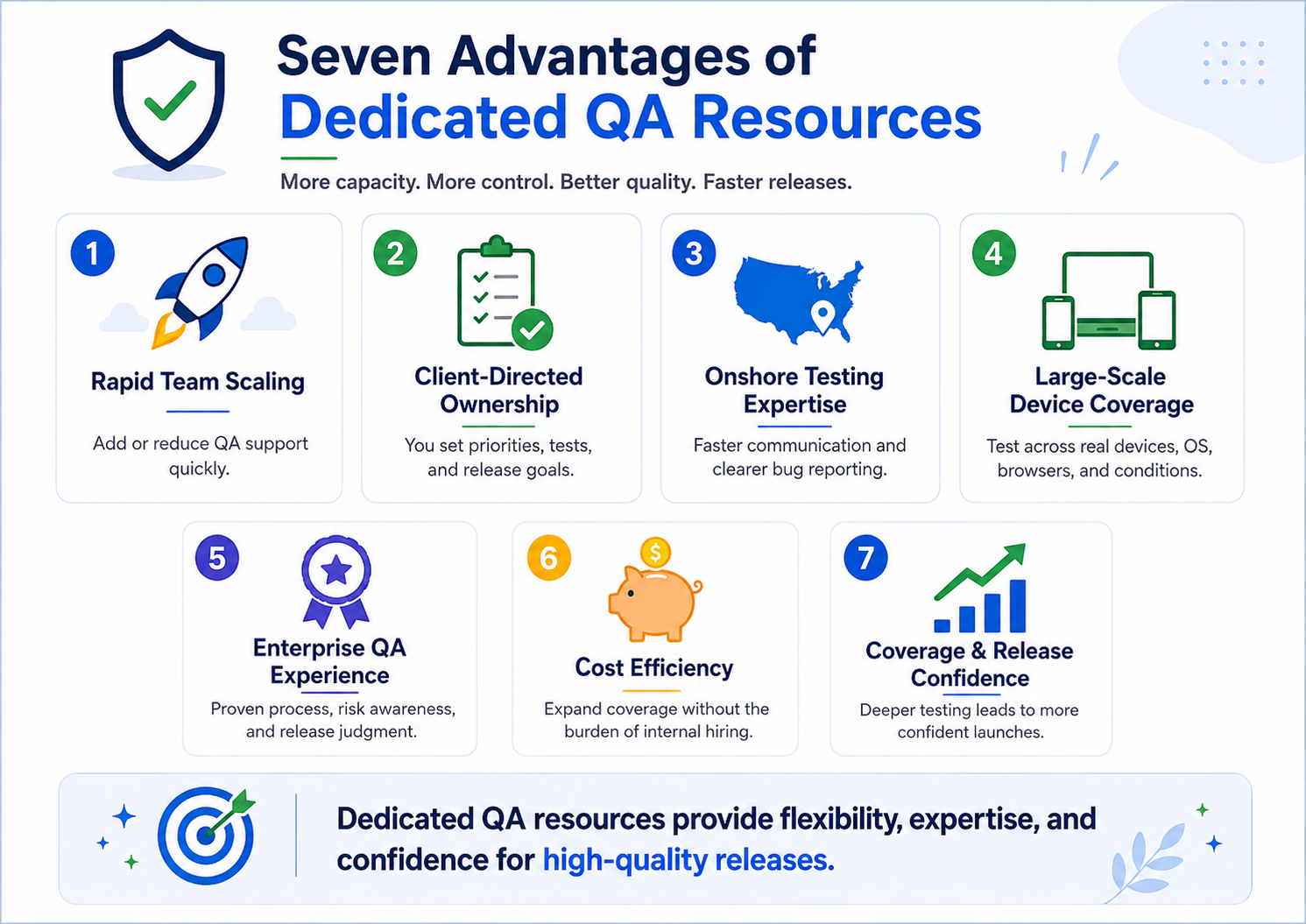
Seven Advantages of Dedicated QA Resources
The value of dedicated QA resources comes from how the support is structured. A team gets added QA capacity, but keeps direct control over priorities, workflows, and release goals. The seven advantages below show where that structure makes the biggest difference for engineering and product teams.
1. Rapid QA team scaling. Dedicated QA resources let teams add testing support faster than traditional hiring allows. Product and engineering leaders can cover launches, large regression cycles, and growth periods without waiting on a full recruiting process. Capacity can also scale down when demand changes, which keeps QA support aligned with testing needs instead of locking every need into a permanent role.
2. Client-directed execution ownership. Clients assign priorities, test cases, workflows, and release goals directly, giving internal QA leads, product managers, and engineering leaders close control over what gets tested and when. Dedicated testers follow the client’s priorities rather than working behind an extra management layer, which keeps testing aligned with product needs as they change.
3. High-quality onshore testing expertise. U.S.-based QA support can reduce communication delays and make daily collaboration easier for teams working in U.S. time zones. It helps during release crunches, bug triage, sprint planning, and fast-moving validation cycles. Strong communication also affects defect reporting quality. A well-written bug report can save engineers time, reduce back-and-forth, and help product teams understand risk sooner.
4. Large-scale device coverage capability. Device coverage is one of the most practical reasons to bring in an outside QA partner. Modern products have to work across operating systems, screen sizes, browsers, hardware generations, and usage conditions. A deep device library gives teams access to broad real-device testing, which can catch hardware- and environment-specific issues that emulators or simulators may miss, without requiring the team to build and maintain that inventory themselves.
5. Enterprise-grade QA experience. Experienced QA professionals bring training, product knowledge, and release judgment from working across products, industries, release cycles, and technical environments. Their background helps when releases involve complex integrations, tighter approval processes, compliance requirements, or workflows where defects could affect customers directly. A mature QA process isn’t only about finding defects. It also includes clear documentation, fix validation, risk identification, and knowing which issues need attention before launch.
6. Cost efficiency without internal hiring burden. Internal QA hiring includes more than salary. Benefits, recruiting time, management time, tools, hardware, and onboarding all add to the total cost of building a larger in-house team. Dedicated resources give teams a way to add testing support with less internal overhead. Teams can increase coverage during launches, releases, or growth periods without turning every short-term need into a permanent role.
7. Improved coverage and release confidence. Dedicated testers build product knowledge over time. They become more useful with every release because they understand expected behavior, common failure points, edge cases, and the client’s quality standards. With more consistent coverage across regression testing, exploratory testing, and device validation, teams can make release decisions with clearer information and fewer last-minute surprises.
How Dedicated QA Resources Operate in Practice
Dedicated QA testers join the client’s existing QA routine rather than working from a separate vendor queue. They use the same issue trackers, test management tools, sprint boards, release calendars, and communication channels as the internal team. The client assigns the work directly, which may include:
- Executing assigned test cases
- Running exploratory testing
- Supporting regression cycles
- Validating defects and retesting fixes
- Documenting results and writing bug reports
- Checking products across devices, browsers, and operating systems
- Reviewing accessibility requirements
- Supporting smoke testing and launch readiness
The exact role depends on how the client releases software. In a sprint-based team, a dedicated tester may validate tickets as they move through development, test new features before release, and retest fixes after engineers respond to defects. In a release-driven organization, the work may focus more on regression cycles, device coverage, smoke testing, and launch readiness.
Over time, dedicated testers become easier to plug into each cycle. They learn the client’s terminology, test environments, documentation habits, release checkpoints, and product risks, which helps them test with fewer long explanations while daily direction stays with the client.
Flexibility in Engagement Models
QA demand rarely stays steady because product needs change from release to release. A team may need deeper device coverage before a launch, broader regression testing after a redesign, or accessibility and documentation support for a new compliance requirement. Dedicated QA resources give teams a way to adjust coverage as those needs change, without hiring a new tester every time testing demand spikes.
QA support can expand or narrow based on the workload. A company may need full-time QA support for a long-term product, part-time testing for variable workloads, or extra coverage during a release push. Larger organizations may need several dedicated testers across product areas, business units, or departments.
As priorities change, QA support can shift toward the areas that need the most attention, from regression coverage to device testing, accessibility checks, or release validation.
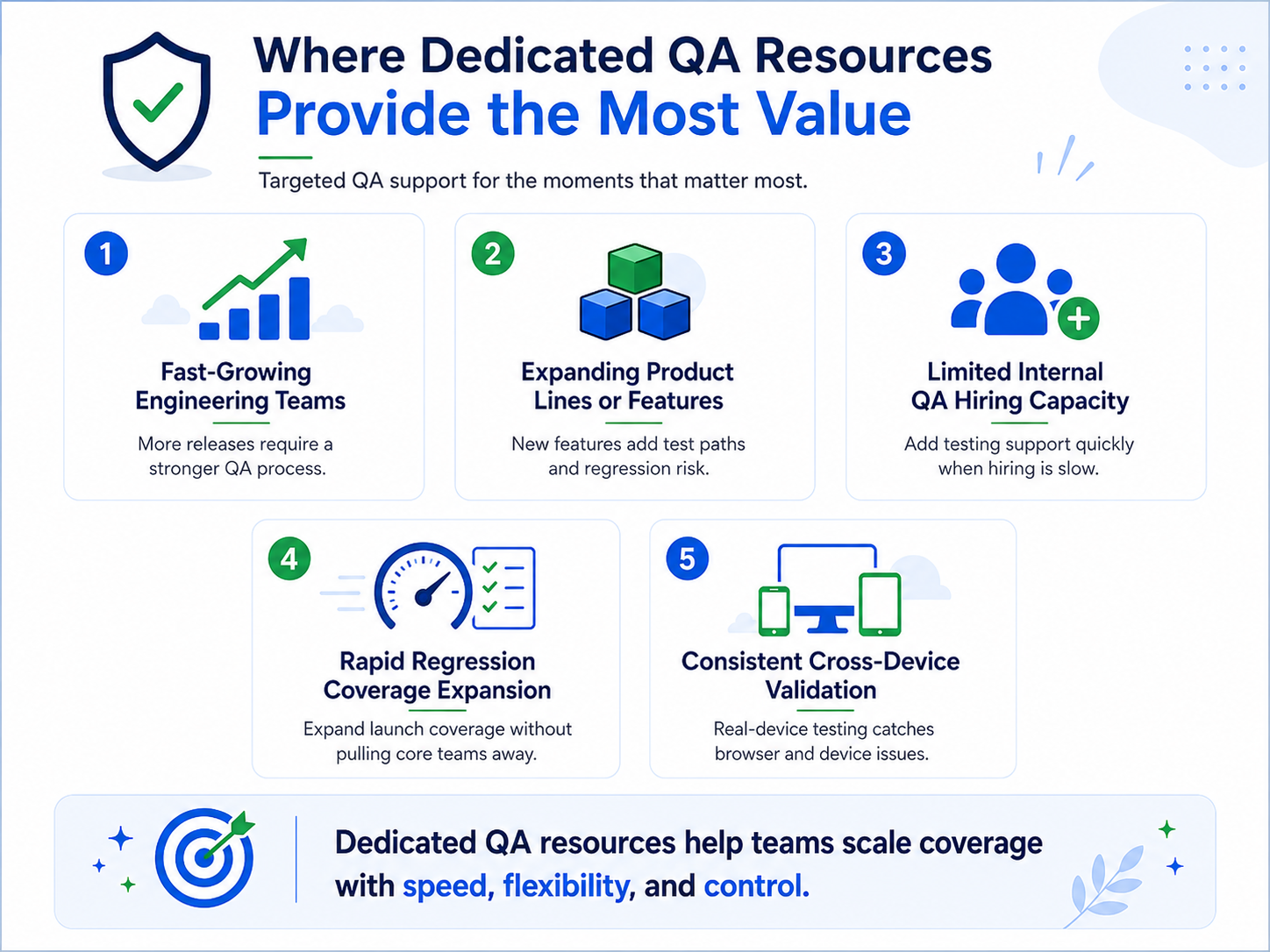
Where Dedicated QA Resources Provide the Most Value
Some QA needs are too urgent for a traditional hiring process, while others are tied to a specific launch, redesign, product expansion, or device coverage gap. In those situations, teams may need targeted coverage without moving daily QA direction away from the product team. The strongest use cases tend to fall into five categories.
- Fast-growing engineering teams. Growth adds users, releases, support expectations, and more work for every part of the product organization. A QA process that worked for a smaller team may need more structure once engineering output increases.
- Expanding product lines or feature sets. Each new product area or feature can add test paths, regression risk, and new ways for users to run into problems. Dedicated testers can help keep that growing test scope organized.
- Limited internal QA hiring capacity. Some teams know they need more testing support, but internal hiring may take too long or require approvals that delay the work. Dedicated QA resources can fill the gap while keeping daily direction with the client.
- Rapid regression coverage expansion. Larger releases, redesigns, and frequent product updates can increase the amount of regression testing needed before launch. Dedicated testers can help teams cover more existing functionality without pulling internal QA leads or developers away from higher-priority work.
- Consistent cross-device validation. Mobile fragmentation, browser differences, operating system updates, and usage patterns can all create issues that emulator-only testing may miss. Real-device testing helps teams see how products perform for users.
Common Misconceptions About Dedicated QA Resources
Misconceptions about dedicated QA resources usually come from confusion about control, communication, continuity, and the role of the outside QA provider. Here are answers to common questions about how dedicated QA resources function.
Are dedicated QA resources just outsourced QA?
Not in the standard handoff sense. Dedicated testers work inside the client’s tools, learn the product, and follow the client’s priorities. The provider supplies the QA support, but daily testing stays tied to the client’s tools, priorities, and release goals.
Does the client lose control over quality?
No. The client still directs daily execution, sets testing priorities, reviews results, and decides which issues need attention before release. Dedicated QA resources add capacity without taking QA direction away from the product team.
Do dedicated QA resources replace internal QA teams?
Usually, no. They often extend an internal QA team by adding coverage for regression testing, device validation, release cycles, or specialized testing needs. Internal QA leads can still guide strategy while dedicated testers help execute the work.
Does communication become harder with an outside tester?
It should not. Dedicated testers can join the client’s channels, meetings, ticketing systems, and documentation processes. They communicate directly with the people building and releasing the product instead of working through a separate vendor layer.
Are dedicated QA resources only useful for short-term needs?
No. They can help during short-term spikes, but long-term assignments are often more valuable. Over time, dedicated testers learn the product, release patterns, and documentation habits, which makes them more useful with each cycle.
How dedicated QA resources support Agile and CI/CD workflows
Agile and CI/CD workflows depend on fast feedback. Developers need to know whether a change works, whether it creates regression risk, and whether the release is still on track.
Dedicated QA resources can support that cadence by helping teams:
- Validate tickets, acceptance criteria, and fixes during the sprint
- Keep regression coverage active across releases
- Support smoke testing before deployment
- Write clear defect reports with reproduction steps and environment details
- Align specialized testing, such as accessibility or security, with the work that needs attention
For teams deploying often, testing cannot wait until the final push before release. Dedicated testers help QA support the same release cadence as product and engineering.
Key advantages over hiring internal QA teams
Hiring internal QA talent can be the right move when a company has stable long-term demand, a clear budget, and time to recruit. Dedicated QA resources make sense when teams need experienced testing support faster, with more flexibility around scale.
Internal QA hiring
- Requires recruiting, interviews, onboarding, and HR support
- Works best when demand is stable and long term
- Builds institutional product knowledge over time
- May require building every testing specialty internally
Dedicated QA resources
- Can add experienced QA support faster
- Works well when demand changes by release, product, or team
- Adds capacity while the client keeps daily direction
- Can bring in testing skills as needed
Client-directed QA support is especially helpful when internal QA leaders already know what needs to be done. They may not need a vendor to take over strategy. They need skilled testers who can join the process, follow the client’s priorities, and carry out the testing plan.
Future of embedded QA models
QA is likely to become more hybrid as product teams balance faster release cycles, broader test coverage, and more specialized testing needs. Testing is already moving earlier into planning and development, while teams still need regression testing, validation, and release support later in the cycle. Several forces are pushing teams toward more flexible QA structures:
- Faster release cycles that need testing throughout development, not only before launch
- More device, browser, and platform combinations to validate
- Greater need to balance manual testing, automation, and human review
- More accessibility, security, and compliance expectations
- AI-assisted testing tools that still need human oversight, product context, and judgment
AI will change how QA teams work, but it does not remove the need for human testing judgment. Capgemini’s World Quality Report says GenAI is affecting quality engineering, while many organizations still face challenges expanding it across the business because of integration complexity, data privacy risks, and skill gaps.
Embedded external QA gives teams a practical way to respond to those changes. Internal teams can keep product knowledge, quality standards, and release priorities close to the business, while dedicated QA support adds coverage, device access, specialized testing skills, and capacity when demand changes.
PLUS QA: Flexible, Client-Managed Testing Support
For many product and engineering teams, QA capacity gets harder to manage as releases move faster, products grow, and testing needs expand to cover more features, devices, platforms, user paths, and release cycles. Dedicated QA resources address that challenge by adding testers who can work within the client’s workflow while internal leaders keep control over priorities, execution, and review.
PLUS QA’s managed testing services cover functionality, accessibility, automation, device compatibility, localization, API, and payment testing, giving your dedicated tester the range to match whatever the release needs.
Alongside those services, PLUS QA’s U.S.-based team has 18+ years of QA delivery experience. We work in a secure testing environment with an 800+ real-device library. Our custom teams can help fast-moving product and engineering teams expand QA support while keeping the work aligned with internal standards and release goals.
When your team needs more testing capacity and still wants direct control over priorities and execution, PLUS QA dedicated resources can help extend your QA team without slowing the release schedule. Contact us to learn how client-managed testing can support your next release, product launch, or growth stage.