
.png)



Why Outsourcing QA Saves Time, Money, and Resources
Some QA bottlenecks build slowly. Others arrive overnight. One travel startup saw its revenue nearly double in a single year, and the testing process built for steady growth couldn't keep pace with what came next. Users started running into mobile device compatibility issues and broken functionality faster than the team could address them. That's a QA bottleneck, and most teams meet some version of it sooner than they expect.
The company didn't patch the problem and move on. It rebuilt how testing fit into its development cycle going forward, treating quality assurance as a permanent part of how it operated rather than something to scramble for during a crisis. We know, because we continue to partner with the company more than a decade later.
Releases ship more often than they used to, and faster release schedules demand more testing every cycle. Hiring more testers is one option. It’s rarely the fastest one. Quality assurance hiring takes time most teams under deadline don't have, and the true cost of hiring competent testers often exceeds their salary. For many teams, the more practical move is to bring in a partner who already has the people, tools, and testing depth ready to go.
What Resource Constraints Look Like in Modern QA
Resource constraints build slowly. A team that handles testing without issues for two years can find itself suddenly behind within a single release cycle. Here’s how:
- Growing test scope: Every feature you ship becomes something you have to keep testing. Regression suites grow with every release, and last quarter's coverage doesn't account for what shipped since.
- Limited headcount: The test team stays the same size while the product, the platforms, and the user base all expand around it.
- Tight release schedules: Shorter cycles compress the testing window. The work doesn't shrink to match. The schedule just gets shorter while the workload stays the same.
- Budget limitations: Headcount is capped, tooling has a ceiling, and the mandate to do more with the same resources doesn't move.
- Specialized testing gaps: Performance, security, and accessibility testing each demand skills a generalist QA team may not carry in-house.
Each of these may be manageable on its own. Together, they become a problem.
The Hidden Costs of Understaffed QA Teams

An understaffed QA team's true cost rarely appears in a single number. It's scattered across defect rates, missed release dates, and employee turnover.
Software engineer Capers Jones studied thousands of software projects. Teams that don't take the time to measure their defect removal process let 15 percent or more of defects reach release. Strong teams aim to keep that number below five percent. The companies that clear that bar don't rely on testing alone. They combine code review, static analysis, and testing together, because testing by itself rarely catches more than half of what's wrong.
How big of a problem is it? The Consortium for Information & Software Quality, which develops software quality standards and measures, put the cost of poor software quality in the United States at $2.41 trillion in 2022. Technical debt alone accounted for roughly $1.52 trillion of that. Those numbers describe the cost of building and maintaining software poorly. They don't capture the cost of the people trying to catch the problems before they ship.
The team itself absorbs the rest of the cost. Testers carrying a permanent overload burn out, and burnout drives turnover. SHRM puts the cost of replacing an employee at 50 to 200 percent of their annual salary, depending on role and seniority, once recruiting, training, and lost productivity during ramp-up are counted. Each departure leaves the remaining team smaller and more overloaded than before, and releases slip while everyone waits on a testing queue that never clears.
Why Hiring More Internal Testers Isn't Always the Answer
Hiring more testers feels like an easy fix. Sometimes it is. Often, though, the time and cost of hiring a new person make it more challenging than outsourcing a solution. Recruiting a qualified tester takes weeks of sourcing, screening, and interviewing before anyone accepts an offer. Onboarding adds weeks more before a new hire is productive. If your team is crunched for time, a hire who's effective three months from now isn’t going to help anytime soon.
The cost runs deeper than a posted salary. In May 2024, software quality assurance analysts and testers had a median annual wage of $102,610. That figure doesn't include benefits, tooling, hardware, or the overhead of managing another person. Finding that person isn’t getting easier. The need for software developers, QA analysts, and testers is expected to grow 15 percent from 2024 to 2034, much faster than the average across all occupations. Demand for qualified candidates isn't slowing down, which makes them harder to hire and slower to bring on.
When It Makes Sense to Outsource QA
Outsourcing makes sense in specific situations, not as a blanket policy. These are the situations where an external team tends to fit best.
- Product launch: You need a surge of testing capacity for a finite window, then far less afterward.
- Rapid growth: Demand is outpacing your ability to hire, and the gap is widening faster than recruiting can close it.
- Large regression cycles: A major release requires broad, repetitive coverage that could overwhelm your core team.
- Specialized testing needs: Performance, security, or accessibility work calls for expertise you don't keep on staff year-round.
- Temporary capacity shortage: A parental leave, a departure, or a crunch quarter leaves a hole you need filled now, not permanently.
An external team often ends up covering more than one of these needs. A company that brings in extra testers for a product launch may keep them on through the regression cycle that follows. By then, the testers already know the product, which means fewer issues slip through in the next stages of development.
For smaller teams, outsourcing does not have to start as a large engagement. It can begin with a focused regression pass, device coverage push, accessibility review, or launch-readiness cycle.
Eight Benefits of Outsourcing QA
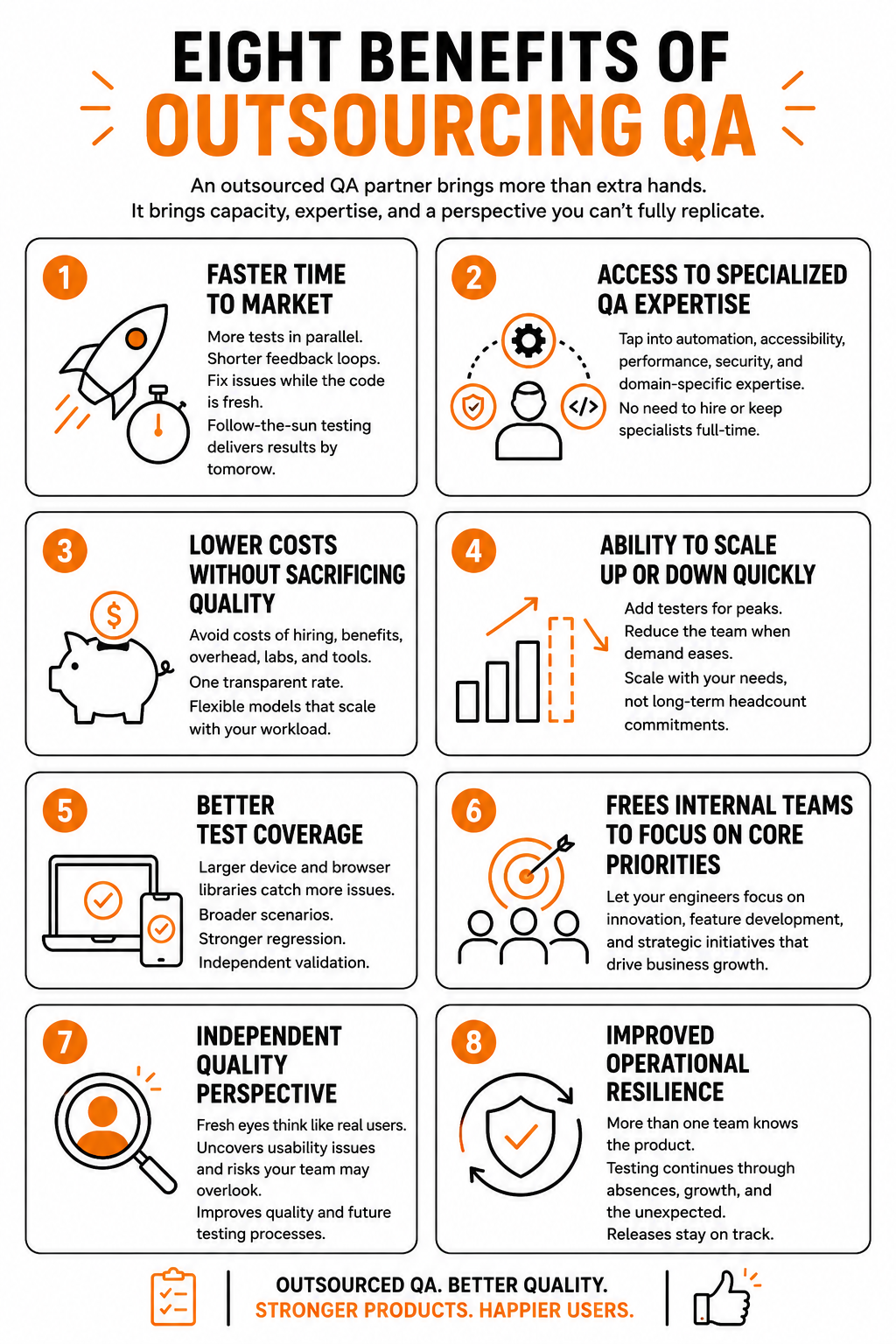
An outsourced QA partner brings more than extra hands. It brings capacity, expertise, and a perspective your own team can't fully replicate, since the people who build a product rarely see it the way a stranger using it for the first time would. The eight benefits below cover what that adds.
- Faster time to market: A dedicated outsourced team can run more tests in parallel than a stretched internal team, which shortens feedback loops. Developers find out what failed and fix it while the code is still fresh in their minds, instead of waiting on one team to clear every build. That helps developers get test results sooner and move fixes through the release cycle faster. For international clients, follow-the-sun testing means teams can test while clients sleep, which delivers fresh results the next day.
- Access to specialized QA expertise: Automation and accessibility testing often require skills many companies do not need full-time. An outsourced partner already employs people who work in those disciplines daily. The same logic extends to performance and security testing, areas a generalist team rarely has time to cover. Many partners also bring testers who understand the regulatory and domain requirements specific to industries like healthcare, finance, or e-commerce.
- Lower costs without sacrificing quality: Recruiting, benefits, payroll overhead, management time, device labs, and test environments all add to the real cost of in-house QA. Many companies do not see the full total until those expenses are counted together. An outsourced partner folds much of that cost into a single rate, while flexible engagement models let spending change with the workload instead of staying fixed all year. Spending matches the work instead of locking into an annual commitment that does not adjust with demand.
- Ability to scale up or down quickly: Testing demand spikes around launches, grows during seasonal peaks, and eases off between cycles. An outsourced partner can add testers for the surge and reduce the team once it passes, which helps companies avoid hiring permanently for demand that may not last. This fits agile teams especially well, since sprint-to-sprint testing needs can shift faster than fixed headcount can.
- Better test coverage: With the right process, more testers can broaden coverage. Outsourced partners typically maintain larger device and browser libraries than a single company keeps in-house, which catches compatibility issues on configurations that weren't tested in-house. Regression coverage expands to match a growing product, broader user scenarios get exercised instead of just the common ones, and an outside team validates the build independently.
- Frees internal teams to focus on core priorities: Every hour your senior engineers spend on routine regression testing is an hour they're not spending on the work only they can do. Handing repeatable testing to a dedicated partner gives your team that time back for product innovation, feature development, and the strategic initiatives that support business growth, including the customer-facing improvements that make your product better.
- Independent quality perspective: A team that built a product knows how it's meant to be used, and that familiarity steers them around the paths a confused first-time user would stumble into. An outsourced tester carries no such familiarity. They test the product as a real user would encounter it, which uncovers usability problems and risks an internal team is less likely to catch on its own. The process gaps they spot along the way often improve how the next release gets tested as well.
- Improved operational resilience: When only one or two people understand how QA works for the product, losing either of them during a critical release leaves a gap nobody else can fill. Splitting testing work between an internal team and an external partner means more than one group knows the product, and testing continues even when someone on the internal team is unavailable. That redundancy supports the business through the unplanned gaps, departures, leaves, and sudden growth that would otherwise stall testing entirely. It means a release can ship with the same level of scrutiny no matter who's out that week.
Common Concerns About Outsourcing QA
These are the questions to ask before signing on with an outsourced partner. And these are the answers you should expect to hear.

Communication
- Question: Will an external team stay in the loop?
- Answer: Yes, through embedded models, shared channels, and a regular meeting cadence that keep an outside team as connected as an internal one.

Knowledge transfer
- Question: How does a partner learn your product?
- Answer: Through structured onboarding, documentation, and a ramp period that a serious partnership plans for from the start.

Time zone differences
- Question: Does distance get in the way?
- Answer: It depends on the partner's model. Some run follow-the-sun coverage, which runs testing overnight with results ready the next morning. Others, including PLUS QA, work the same business hours as their clients. Questions get answered the same day instead of waiting on a delayed handoff across time zones.

Security concerns
- Question: Can an outside team be trusted with sensitive data?
- Answer: Yes. A serious partner should be able to explain how its security practices align with recognized frameworks like NIST's Secure Software Development Framework. They should also be willing to sign whatever access controls and agreements your security policies require.

Testing quality
- Question: Does outsourcing mean weaker testing?
- Answer: No. Not when the work is built around clear test plans, shared defect reporting, defined KPIs, and regular review. The right setup gives you a way to check the work, track progress, and catch issues early.

What Separates a Successful Engagement From a Failed One
The difference between an engagement that delivers and one that disappoints comes down to a handful of practices, and the mistakes that undo them.
Practices That Work
- Clear ownership models: Everyone knows who owns what, which tests, which environments, which decisions. Nothing is left unassigned.
- Defined KPIs: Success is measured against numbers both sides agree on in advance, like coverage, defect detection, and turnaround time.
- Embedded partnership: The partner understands the scope, priorities, reporting cadence, and definition of success before testing begins.
- Consistent communication: A steady rhythm of check-ins and reporting keeps both sides aligned as priorities shift.
- Documentation standards: Shared, maintained documentation lets knowledge persist and new testers ramp without starting from zero.
Mistakes That Don't Work
- Lack of oversight: Hands-off isn't the same as set-and-forget. Engagements need an owner on your side.
- Unclear requirements: A partner can only test against what you've defined. Vague scope produces vague results.
- Misaligned expectations: When the two sides expect different outcomes, both end up disappointed by the same result.
- Poor onboarding: Skip the ramp, and even strong testers spend weeks guessing at context they should have been given.
- Choosing on price alone: The cheapest bid often turns into the most expensive engagement once rework and missed defects are counted.
In-House vs. Outsourced QA: Which Is Right for You?
There's no universal answer, only the right fit for your situation. Here’s a comparison of what they offer:

Cost
- In-House: Fixed salaries plus benefits, tooling, and infrastructure, paid year-round
- Outsourced: Variable, aligned to actual workload; no standing overhead

Scalability
- In-House: Limited by hiring speed and headcount budget
- Outsourced: Elastic - scale up or down as demand moves

Expertise
- In-House: Deep product knowledge; may lack specialized niches
- Outsourced: Access to specialists across automation, performance, security, accessibility

Speed
- In-House: Constrained by team size and time zone
- Outsourced: Expandable capacity, reduced bottlenecks

Product context
- In-House: Built-in familiarity
- Outsourced: Built through onboarding and embedded collaboration
For most teams, the answer is a hybrid model. A permanent internal core handles product-specific work, while an external partner covers scale, specialization, and surge.
The Rise of Dedicated QA Teams
Outsourcing used to mean a vendor ran one project and disappeared. What engineering leaders increasingly want now is a dedicated team. The same testers partner with you engagement after engagement, functioning as an extension of the internal group. Dedicated teams outperform the old model for a clear reason. They accumulate product knowledge instead of resetting it every contract. They adopt your processes, share your tooling, and carry continuous ownership of quality rather than treating each release as a one-off.
The travel startup is a clear example. A response to one growth spike became a decade-long partnership spanning new platforms, new features, and an entirely different scale of product than the one PLUS QA first tested. Long-term partnerships, like long-tenured employees, get more valuable over time.
What Modern Engineering Leaders Expect From QA Partners
Expectations for QA partners have risen. A QA partner today is measured against a higher bar than 'find the bugs.' Leaders look for:
- Business alignment: Testing prioritized by what carries the most risk to the business.
- Risk management: A partner who identifies and ranks risk, helping you decide what must be solid before a release ships.
- Quality metrics: Transparent, shared measurement that ties testing work to outcomes everyone can see.
- Automation expertise: The engineering depth to build maintainable automated coverage.
- Continuous improvement: A relationship that gets sharper over time, refining process and coverage release after release.
A partner who meets that bar contributes to the quality of what you ship.
PLUS QA: Your Experienced Outsourcing Partner
Resource constraints test a team's discipline. Teams that plan for those constraints in advance keep defect rates low and coverage steady. Teams that don’t plan ahead can see defect rates rise and coverage shrink. Outsourcing delivers flexibility and specialized expertise on a timeline and budget internal hiring can't match. A spike in demand, a launch, or a gap in specialized skills calls for capacity that scales with the need.
The strongest engagements build shared ownership of quality. A partnership means the outsourced team understands the product well enough to make decisions about risk and coverage alongside the internal team. The right QA partner functions as an extension of your team.
PLUS QA builds dedicated QA teams that are flexible enough to scale with launches and seasonal demand, deep enough to cover both manual and automated testing, and ready without the hiring delays that can slow testing when the release schedule is already tight. Once you've decided outsourcing fits, the next step is finding the right partner. Check out our guide to choosing a QA testing partner to learn more about what to ask and what to watch for. If you're already stretched thin and ready for an outsourced partnership, contact us today.