WCAG: Web COntent accessibility guidelines

WCAG is an international set of standards created by the W3C to make digital content such as websites, mobile and web applications accessible to people with disabilities. The range of people includes users with visual, auditory, motor and cognitive impairments.

Man sitting at desk with laptop pointing a pen at illustrated checklists hovering infront of him
Graphic image of hand, ear, eye, and side profile of a face icons displayed in different colored tiles

Understanding WCAG

The internationally recognized and technically precise standards for digital accessibility are the Web Content Accessibility Guidelines (WCAG), specifically versions 2.0 and 2.1. These foundational guidelines provide a clear, structured, and referenceable framework for making web content accessible to individuals with a broad spectrum of disabilities, including visual, auditory, physical, speech, cognitive, language, learning, and neurological impairments.

Meanwhile the most recent version of WCAG version 2.2 adds new success criteria focused on improving accessibility for users with cognitive and motor disability. That includes a clearer focus visibility, larger touch targets and simpler authentication. These guidelines apply to content across all devices and often improve general usability.

Heading

WCAG is structured around four core principles, summarized by the acronym POUR: Perceivable, Operable, Understandable, and Robust. These principles define what makes digital content accessible to users with disabilities. Content accessibility quality is evaluated by how effectively it meets or surpasses WCAG expectations, with the goal of maximizing accessibility for the widest possible audience.

Woman holding a phone with Plus QA website displayed on screen

Ensuring High Standards of accessibility


Vision

  • Text spacing and sizing
  • Color scheme and contrast
  • No risk of seizures
  • Ease of navigation
  • Magnifier / zoom usability

Hearing

  • Video captions provided
  • Text alternatives provided
  • Ease of navigation

Physical

  • Keyboard-only usability
  • Mouse-only usability
  • Screen reader usability
  • Ease of navigation
  • Usability with images turned off

Cognitive

  • Time-based media alternatives provided
  • Enough time to access content
  • Ease of navigation
  • Usability with images turned off
  • Mouse-only usability

The Pour Principles

The POUR principles are the lens through which content accessibility quality should be evaluated. Success in meeting or exceeding the expectations set forth by the Web Content Accessibility Guidelines (WCAG) is directly measured against how thoroughly a piece of content adheres to these four principles. The ultimate goal is to ensure that digital content is as accessible as possible to the broadest range of individuals, including those with disabilities.

  • Perceivable: Information and user interface components must be presentable to users in ways they can perceive. This means the content cannot be invisible to all their senses. For instance, providing text alternatives for non-text content (like image descriptions or captions for audio/video) ensures that users who cannot see or hear the original content can still access the information.

  • Operable: User interface components and navigation must be operable. This ensures that users can successfully interact with the content and complete necessary actions. Examples include ensuring all functionality is available from a keyboard (not just a mouse) and giving users enough time to read and use the content.

  • Understandable: Information and the operation of the user interface must be understandable. Users must be able to comprehend the content and how to use the interface. This involves making text readable and predictable, and ensuring the interface is intuitive and consistent in its design and function.

  • Robust: Content must be robust enough that it can be interpreted reliably by a wide variety of user agents, including assistive technologies. This means that as technologies advance, the content should remain accessible, relying on well-formed markup and compatibility with various tools and platforms.

perceivable

  • Text alternatives
  • Time-based media
  • Adaptable
  • Distinquishable

Operable

  • Keyboard accessible
  • Enough time
  • Seizures and physical reactions
  • Navigable
  • Input Modalities

Understandable

  • Readable
  • Predictable
  • Input assistance

robust

  • Compatible

    (Website content and back-end coding to be compaitble with assitive technologies)

Success Criteria

At the core of the WCAG framework are Success Criteria—a set of testable, definitive statements. These "must-do" items ensure consistent and verifiable conformance, allowing developers, designers, and auditors to objectively assess whether content meets the necessary accessibility standards.

These Success Criteria are systematically categorized into three distinct Levels of Conformance:

  1. Level A (The Minimum): This is the most basic level of conformance. It addresses the most critical barriers to accessibility. Content must satisfy all Level A Success Criteria, otherwise, it would be impossible for some groups to access the information. Achieving this level is the absolute minimum requirement for accessibility.

  2. Level AA (The Accepted Standard): This is the primary and most commonly targeted level of conformance for most organizations and accessibility laws worldwide. Level AA success criteria address the biggest and most common barriers for the majority of users with disabilities. Satisfying all Level A and Level AA criteria ensures that the content is accessible and usable by a much broader audience, dramatically improving the user experience for people with disabilities.

  3. Level AAA (The Highest Standard): This level represents the highest standard of accessibility. The criteria at this level address highly specific needs and situations. While achieving Level AAA is highly desirable, it is generally not possible to satisfy all Level AAA Success Criteria for all content because some criteria may conflict with each other or with the nature of the content itself. This level often involves enhancements that go above and beyond what is typically mandated but provides the most robust access for all users.

These three levels ensure that the guidelines can be applied in different contexts, addressing the diverse needs of various user groups, specific technologies, and organizational capacity for implementation.

Our testing approach

Every client is unique, which is why every project begins with an assessment of client needs. An audit shows us how your product functions and what testing you need to optimize its performance. Our accessibility testing team can then create specific scenarios that replicate the experiences of potential users who have disabilities.

Once testing is complete, we provide you with a thorough report that gives clients insightful and actionable information about how to address accessibility issues.

Our job is not complete until we have confirmed each issue is solved and we can sign off on the final project.

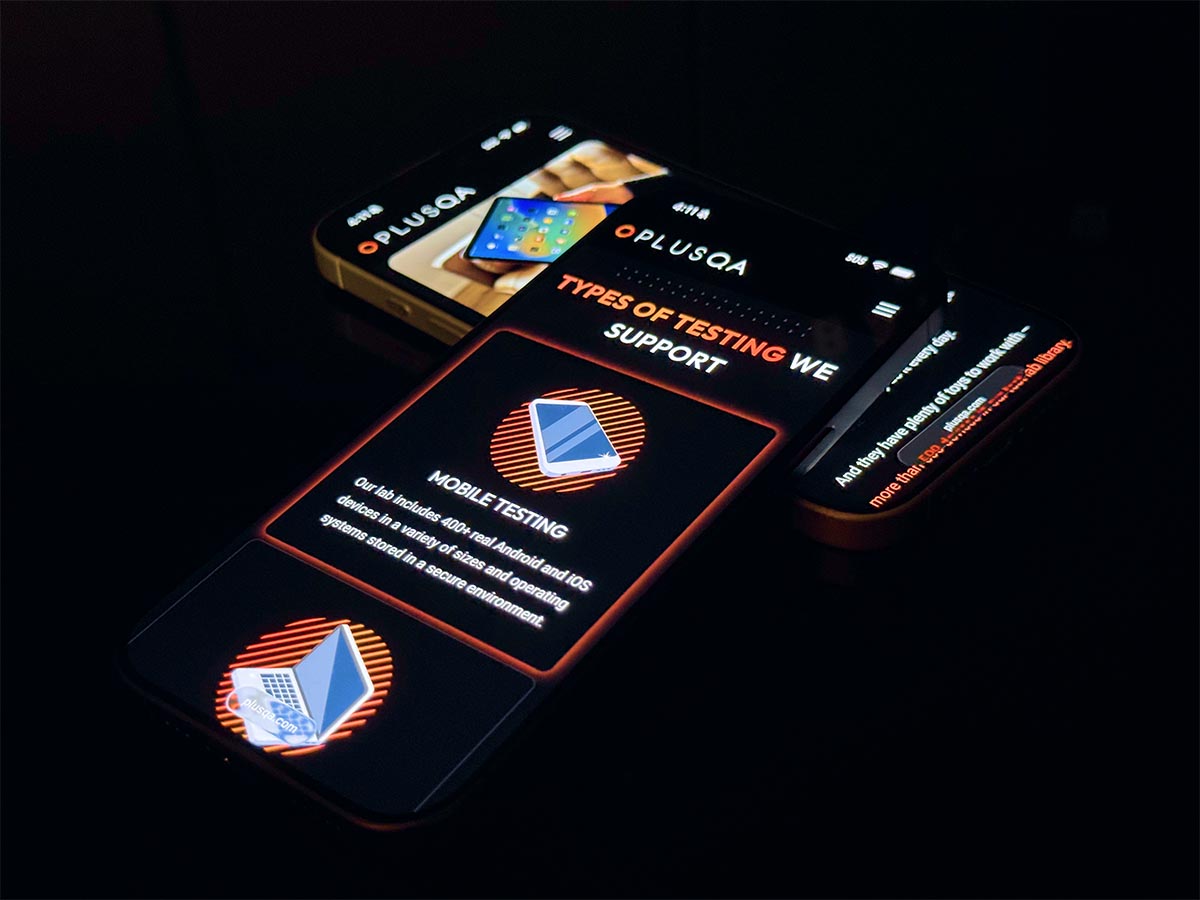
Two mobile devices stacked on top of each other with PlusQA website pages displayed on screen
A menu displaying keyboard shortcuts that can be used with Test Platform's 'Test Pass' feature

Our Accessible Test Platform

Our team developed a custom platform that allows us to streamline the testing process. Test Platform utilizes a comprehensive suite of test management tools that accelerate testing without losing performance quality.

We built Test Platform in accordance with Web Content Accessibility Guidelines (WCAG) 2.1 to ensure it is accessible to every tester at PLUS QA and every client who hires us. Our intuitive design allows every user, regardless of ability, to access bug tracking, test cases management, and other features.

To learn more about Test Platform’s accessibility features, you can read more on our development blog.

ready to start testing?

See why hundreds of businesses choose to test their websites and apps with PLUS QA.

  • 17 yEARS OF EXPERIENCE IN SOFTWARE TESTING

  • US BASED COMPANY

  • testing in a secure environment

  • 600+ DESKTOP AND MOBILE DEVICES

  • CUSTOM QUALITY ASSURANCE TEAMS

  • SAVE COSTS ON ENGINEERING AND QUALITY

contact us

Complete the form below and a member of our team will be in touch soon.

* denotes a required field.

Thank you! Your submission has been received!
Oops! Something went wrong while submitting the form.

STAY UP TO DATE WITH OUR BLOG

November 3, 2025

Why Automating Web Accessibility Testing Isn't Enough

READ BLOG

October 22, 2025

AI vs Human Testers: What is the Real Advantage?

READ BLOG

October 10, 2025

What to Expect at the 2025 Pacific Northwest Software Quality Conference (PNSQC)

READ BLOG

October 8, 2025

Design for Inclusivity: 5 Ways to Make Your App More Accessible

READ BLOG